

Booking therapy for your child can bring a second set of questions: What should I tell them? Will I stay in the room? What if they do not want to talk? You do not need to have all of that figured out before asking for help.
A first play therapy appointment is a starting point for getting to know your child and your family. At Social House Wellness Company in Katy, our play therapy service begins with a parent meeting, followed by care shaped around your child’s developmental needs. Confirm who should attend the first appointment when you schedule.
Before you come: ask who the first meeting is for
Ask whether the initial visit is for a parent or caregiver, your child, or both. This helps you arrange childcare if needed and gives you space to discuss sensitive concerns without asking your child to sit through an adult conversation about them. Your therapist can explain how they include each caregiver and what information they need before treatment begins.
Bring a few concrete observations: when the difficulty began, where it happens, what seems to help, and what has changed recently. “Bedtime has taken two hours most nights for the past month” gives a clearer starting point than “They are always difficult.” Include strengths, interests, and moments when your child seems comfortable, too.
What should I tell my child about play therapy?
Keep the explanation brief, honest, and appropriate for their age. You might say: “We’re going to meet someone who helps kids with feelings and things that are hard. There will be things to play with, and you can get to know them.”
If your child asks why, connect it to something they recognize: “Mornings have felt really hard lately, and we’re getting some help.” Avoid presenting therapy as a punishment or a place where someone will make them behave. You also do not need to promise that they will love every visit.
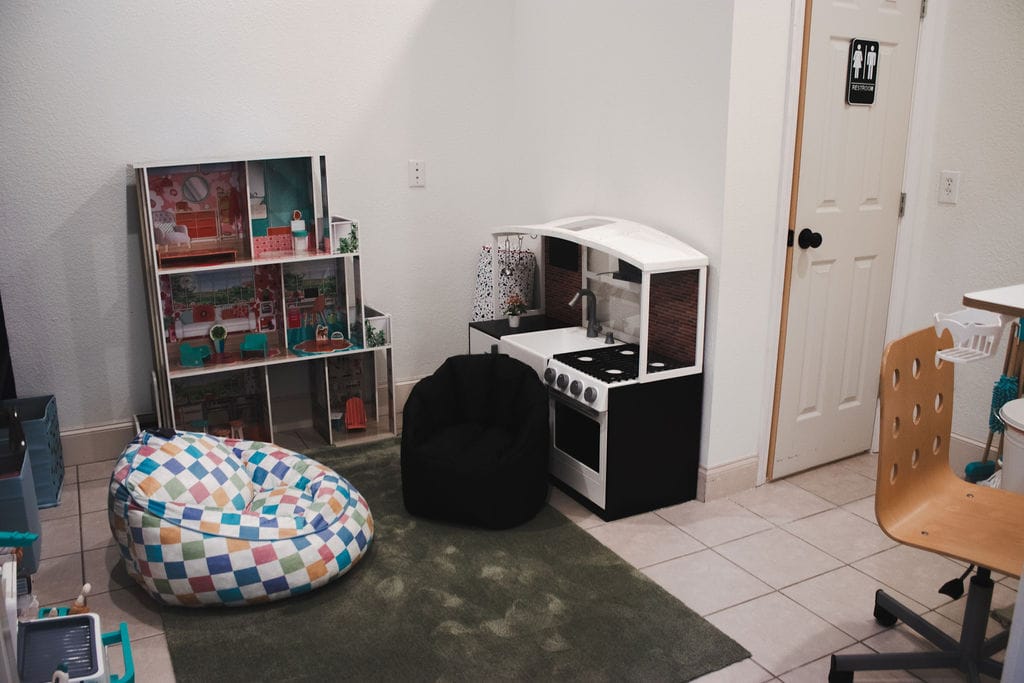
Show them the playroom photo if they are curious. Explain what you know about the visit and let the therapist answer questions you cannot answer yet, including whether you will stay nearby or join them.
What happens when my child meets the therapist?
Early visits give your child time to become familiar with the room, the therapist, and the process. The therapist may use play materials or creative activities to connect with them and learn how they express themselves. The exact activities depend on the child and the therapist’s approach.
A child might explore right away, watch quietly, stay close to a caregiver, or ask many questions. You can tell the therapist about sensory preferences, communication needs, or separation worries before the visit so these can be considered in the plan. Your child does not need to arrive ready to explain everything in words.
Will I be in the room?
Ask your therapist rather than assuming there is one rule for every family. Caregiver participation can vary with your child’s age, needs, comfort, and treatment approach. At Social House, parent check-ins are part of staying involved and discussing ways to support your child at home.
It is useful to ask how updates will work, what will be shared with you, and how the therapist protects your child’s privacy while addressing safety concerns. Agree on a way to share important observations between visits without turning each pickup into a detailed discussion in front of your child.
What should I do after the appointment?
Leave room for an ordinary transition afterward. A snack, a familiar routine, or a quiet ride home may be enough. You can say, “You can tell me about it if you want to,” without asking for a report on everything they played with or said.
If your child shares something, listen without trying to interpret it. You can bring questions to the therapist through the agreed communication channel. Tell the therapist about concerning changes or distress rather than assuming that every difficult reaction is a normal part of treatment.
How will we know whether it is helping?
Choose practical goals with your therapist: easier transitions, more ways to express frustration, or less disruption from worry, for example. Ask what changes to watch for and when you will review progress together.
One appointment cannot establish how the whole course of care will go. Your observations between sessions matter, and the plan can be discussed as you learn what your child needs. Ask questions if you are unclear about the goals or whether the approach is a good fit.
Questions worth asking before you book
What experience do you have with children my child’s age? Who attends the first appointment? How long are visits, and how often might we meet? How do parent check-ins work? What is the fee, and does my insurance apply with this clinician? What should I do if a concern comes up between sessions?
Play therapy at Social House in Katy
We offer in-person play therapy for children through age 11 in our dedicated playroom at 1806 Snake River Rd, Suite B, Katy, TX 77449. Our team can help you discuss fit based on your child’s age, needs, and clinician availability.
Ask our team about getting started, request an appointment, or call 832-284-7354. Please use the secure intake process for detailed personal or clinical information.
If you are still deciding whether to seek support, read Shyness, Tantrums, and Play Therapy: A Parent’s Guide.
For more about the process, visit the Association for Play Therapy’s guide to what happens in play therapy. Individual treatment plans and appointment arrangements vary.